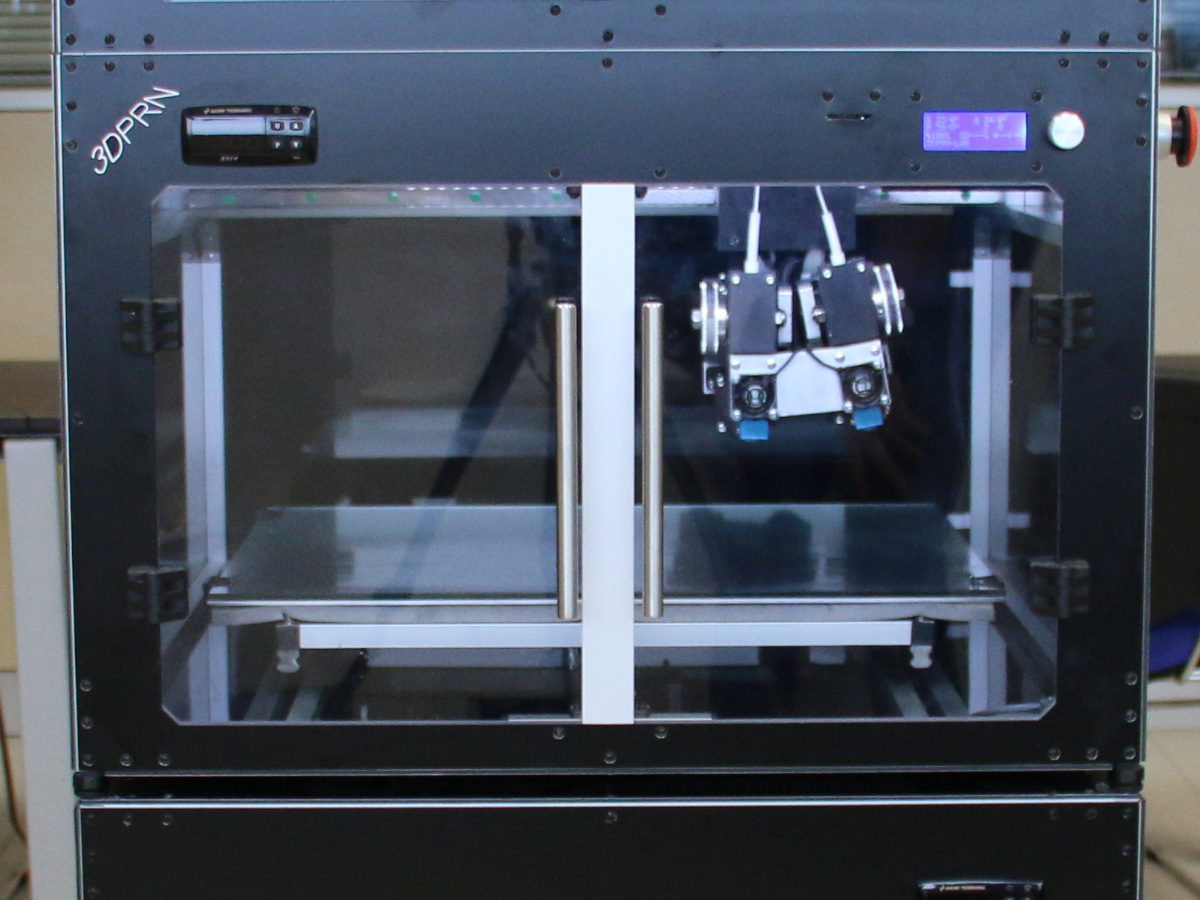
Large-format professional 3D printers represent an increasingly attractive solution for companies needing to produce technical and industrial components quickly, precisely, and flexibly. Advances in additive manufacturing have significantly increased the size of parts that can be produced, opening up new possibilities for industries that work with bulky components, functional prototypes, equipment, and small production runs.
In the industrial sector, the ability to produce a large component directly from a digital file can streamline several stages of the process. Professional large-format 3D printing allows you to go from design to physical object without having to use molds, specialized equipment, or complex manufacturing processes at each stage of development.
This feature is particularly useful when custom components, one-of-a-kind pieces, or small quantities are needed. Furthermore, the ability to quickly modify a CAD model makes it easy to create different versions and adapt the component to specific needs.
What is a large-format professional 3D printer?
A large-format 3D printer is an additive manufacturing system designed to produce objects that exceed the usual dimensions of conventional 3D printers.
In the industrial sector, large-scale production allows for the production of anything from relatively bulky components to very large parts. Depending on the application, the object can be produced as a single piece or divided into several modules that are then assembled.
Large-format printing shouldn’t simply be considered an increase in machine size. A professional solution must also offer stability, precision, repeatability, and the ability to work with materials suitable for technical applications .
Technical components made using 3D printing
Industrial companies use components with very different characteristics. Some must be lightweight, others require mechanical strength, thermal stability, or the ability to withstand specific stresses.
Additive manufacturing allows you to adapt geometry and materials to the specific needs of the project. This facilitates the production of customized components that might otherwise be difficult to produce with traditional processes, especially in small quantities.
Possible applications include:
- Technical envelopes and covers .
- Functional supports and structures.
- Machinery components.
- Models and tools.
- Custom components.
- Functional prototypes.
- Large-scale technical models.
- Elements intended for assembly processes.
- Special tools.
- Components for small productions.
The ability to produce directly from a digital model offers great freedom during the development phase.
Benefits for the sector
Using a large-scale professional 3D printer can bring benefits at various stages of an industrial project.
One of the most important advantages is the reduction in time required to go from design to production of the first part. Additive manufacturing allows you to start production directly from the digital file, eliminating several intermediate steps.
The ability to quickly modify the design is another valuable feature. If a component needs to be adapted to new dimensions or requires a functional modification, the CAD model can be updated and used for the new production.
Key benefits include:
- Reduce development times .
- Greater flexibility in the production of custom components.
- Possibility of producing large components.
- Reduction of certain tools and molds.
- Cost-effective production of unique components and small series.
- Greater freedom in developing complex geometries.
- Optimization of material consumption.
- Ease of running multiple iterations of the same component.
Precision in large components
Dimensional accuracy is essential for technical and industrial components. A component must meet established measurements and tolerances to integrate properly with other elements.
Maintaining precision can be more challenging for large components because even a small deviation can significantly affect the overall dimensions. Therefore, a professional 3D printer must ensure a stable structure and precise movement. It’s also essential to control factors related to temperature and material behavior during the manufacturing process.
Process planning is equally important. Part orientation , layer distribution, and support quantity can influence the characteristics of the final result.
Materials for industrial components
The choice of material must be related to the component’s end use. Not all applications require the same mechanical or thermal characteristics.
Additive manufacturing systems can work with different thermoplastic materials , depending on the technology and machine configuration.
Options used in professional applications include:
- PLA for certain models and prototypes.
- ABS.
- PETG.
- Polycarbonate.
- Polyamides.
- Reinforced materials.
- Composite materials .
For components subjected to certain loads, the use of fiber-reinforced materials can be advantageous. These solutions allow for the appropriate combination of stiffness, strength, and weight .
However, each material requires specific processing conditions and must be selected taking into account the expected behavior of the component.
Reinforced materials and functional components
Composite materials offer additional possibilities for certain industrial applications.
The incorporation of fibers can modify the mechanical characteristics of the material and enable the production of components with specific properties. In some cases, this can be advantageous for tools, supports, or parts that require a combination of lightness and rigidity.
The choice of material must also take into account the working environment. Temperature, humidity, exposure to certain agents, and mechanical stress can influence the component’s behavior.
For this reason, before selecting a material, it is advisable to analyze the actual conditions of use of the component .
CAD design for additive manufacturing
One of the great advantages of 3D printing is the direct relationship between digital design and manufacturing .
The CAD model shouldn’t simply reproduce a component designed for a conventional manufacturing method. Designing for additive manufacturing allows you to take advantage of the specific capabilities of 3D printing.
An industrial component may incorporate lightweight internal structures, channels, reinforcements, complex geometries, or connection systems that would be difficult to produce using some traditional processes.
The goal is to develop a process-optimized component, reducing weight, material consumption and production times wherever possible .
Production of one-piece components
One of the most interesting advantages of large-format technologies is the possibility of producing large technical components in a single piece .
When geometry and production volumes allow, this strategy can reduce the number of joints and simplify assembly.
In some industrial applications, reducing the number of components to be assembled can help decrease production times and simplify component management.
However, the production of large components requires careful control of thermal and dimensional stability to avoid deformations that could compromise quality.
Modular production for large components
When the dimensions exceed the machine’s capacity, modular manufacturing allows you to continue working with large parts. The component is divided into different sections designed for subsequent assembly. Connections can be integrated directly into the CAD model for precise assembly.
This strategy also offers a significant advantage during modifications. If a part of the component needs to be replaced, in some cases it may be sufficient to rebuild just that section.
In this way, 3D printing offers great production flexibility even for objects that exceed the build volume of a single machine.
Speed and productivity
In an industrial company, simply producing a component correctly isn’t enough. The process must also be productive.
Print speed must be evaluated in relation to quality, stability, and reliability. Excessively increasing speed can negatively impact some component characteristics, while an overly conservative setting can unnecessarily prolong production.
Productivity also depends on setup times, the amount of material used, support structures and subsequent operations.
For this reason, optimization must seek a balance between time, quality and resource consumption .
Reliability and repeatability
When a 3D printer is used to produce industrial components, reliability is especially important.
Producing a large component can take many hours. A mistake in the final stage of the process can result in significant wasted time and material.
Machine stability, thermal control, material feeding, and proper parameter settings all contribute to improved repeatability.
The ability to reproduce the same result multiple times is especially important when 3D printing is used for small series or functional components .
3DPRN and the production of industrial components
In the field of professional large-format 3D printing , 3DPRN is associated with solutions aimed at the additive manufacturing of large components.
When evaluating a professional solution, it’s important to consider the project’s actual needs. Print volume is just one of the relevant factors. Precision , material compatibility, productivity, reliability, and the characteristics of the parts to be produced must also be considered .
An adequate solution should allow the use of large formats without compromising the performance required for industrial applications.
Applications in industrial prototyping
Prototyping continues to be one of the most important applications of additive manufacturing.
Technical components created through 3D printing can be used to verify dimensions, assembly, ergonomics, and functionality before moving to final production. The ability to produce multiple versions also facilitates experimentation. A design can be modified after testing and quickly transformed into a new prototype.
This process helps reduce the time required to validate a solution and identify potential problems early in the project.
Production of tools and equipment
Large-format 3D printing can also be used to create custom tools, patterns, and manufacturing equipment .
A company may need specific support for an assembly operation or a model adapted to a particular component. Producing these items through 3D printing allows for customized solutions without having to resort to lengthy and complex processes.
Furthermore, when the instrument is no longer needed or needs to be modified, the digital model can be updated and reproduced.
This flexibility is particularly interesting for companies that work with variable or highly customized production .
How to optimize the cost of a large part
The cost of a printed component does not depend solely on the amount of material used.
To evaluate production efficiency, it is necessary to consider the total cost of the process , including machine time, energy, setup, labor, supporting materials, and subsequent operations.
Correct orientation can reduce the number of supports required. An optimized internal structure can reduce material consumption. A modular design can facilitate production and transportation.
Therefore, optimization should be done right from the design stage and not only when the part is ready for printing.
The future of 3D-printed industrial components
The evolution of industrial additive manufacturing is progressively expanding the applications of 3D printing.
Advances in materials, software, and control systems enable the development of solutions increasingly suited to the needs of the sector.
The combination of large production volumes with technical materials opens up the possibility of producing larger components with more complex geometries.
At the same time, the integration between CAD, simulation and digital manufacturing allows components to be optimized before their production, reducing certain errors and improving efficiency.
The professional large-format 3D printer for technical and industrial components offers a combination of flexibility, production capacity and design freedom that is particularly attractive for the industrial sector.
The ability to produce prototypes, tools, models, functional components, and small series allows companies to respond more quickly to specific needs.
Appropriate material selection, CAD model optimization, control of printing parameters, and proper process planning are essential to achieving reliable results.
Furthermore, single-piece or modular production allows the process to be adapted to different sizes and production needs.
In this context, large-format 3D printing represents a technology with growing potential for the production of technical and industrial components. Its ability to combine large dimensions, customization, precision, and efficiency makes it an increasingly important tool for companies looking to modernize their processes and develop new manufacturing solutions.